Solar Photovoltaic System Design Workshop
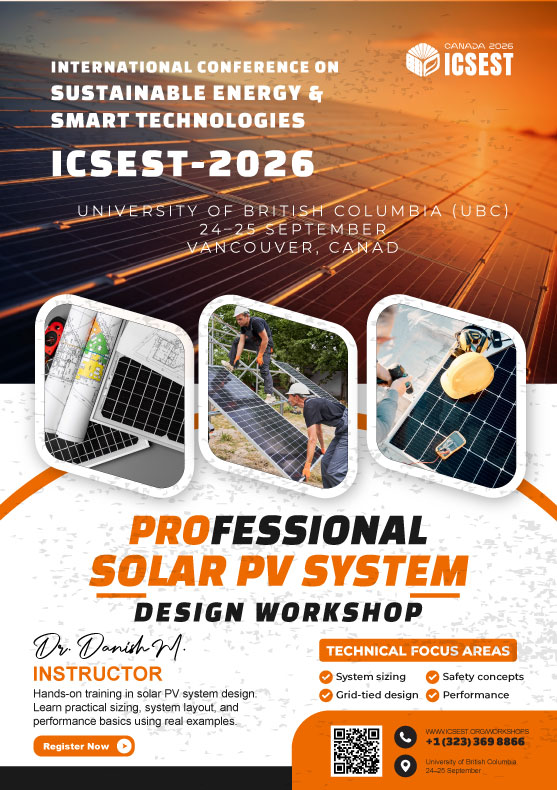
The Professional Solar Photovoltaic (PV) System Design Workshop is planned as a technical training activity within the 4th International Conference on Sustainable Innovations and Partnerships (SIP 2027). The workshop introduces practical and engineering-oriented methods for designing solar PV systems, with emphasis on grid-connected applications.
The session focuses on real-world design workflows, datasheet-based calculations, code-aware design concepts, system sizing, layout planning, and basic performance evaluation. It is suitable for participants seeking a clear and replicable approach to PV system design and renewable energy project development.
Learning Outcomes
By the end of the workshop, participants will be able to explain the main design steps used in professional PV system development.
- Understand core PV system components and operating principles.
- Interpret PV module and inverter datasheets for design use.
- Perform basic PV system sizing calculations.
- Explain grid-connected PV system architecture.
- Identify key safety, protection, and code-aware design concepts.
- Estimate system performance at a screening level.
- Recognize common design limitations in real PV project development.
Technical Coverage
The workshop will provide a structured overview of solar PV system design. The technical coverage is designed for a mixed audience of students, researchers, engineers, and sustainability professionals.
- PV system fundamentals and energy-conversion principles.
- PV module parameters and datasheet interpretation.
- Inverter selection and grid-connected system architecture.
- Basic system sizing principles and design constraints.
- String sizing, voltage limits, and temperature considerations.
- Safety, protection, and installation-related design concepts.
- Performance estimation and screening-level energy yield evaluation.
- Practical design workflow for early-stage PV project planning.
Workshop Format
- Type: Professional technical workshop.
- Delivery: In-person, with possible supporting materials for registered participants.
- Duration: 3 hours.
- Planned schedule: During SIP 2027, 18–19 March 2027, subject to the final conference program.
- Method: Instructor-led training with worked examples and practical design discussion.
- Venue: University of British Columbia (UBC), Vancouver, Canada.
Target Audience
The workshop is designed for participants who want a practical introduction to PV system design and renewable energy project planning.
- Undergraduate and graduate students.
- Academic researchers and early-career scholars.
- Electrical and renewable energy engineers.
- Solar industry professionals and project developers.
- Energy planners, sustainability officers, and practitioners.
- Participants interested in applied clean-energy training.
No prior PV design experience is required. Basic electrical knowledge is recommended.
Instructor
Delivered by: Dr. Mir Sayed Shah Danish and team.
Dr. Mir Sayed Shah Danish is an energy systems expert and academic author with experience across applied engineering practice, renewable energy education, and technical capacity building. His work focuses on solar photovoltaic system design, sustainable energy systems, smart technologies, and structured engineering training.
Biography: https://www.mdanish.me/
Materials Provided
Registered workshop participants may receive supporting materials to assist with learning, practice, and future review.
- Workshop presentation slides in PDF format.
- Example calculations and design worksheets.
- Datasheet-based design examples.
- Reference list for further study.
- Selected practical notes for early-stage PV design work.
Registration
Workshop participation requires SIP 2027 conference registration. Additional workshop registration details, eligibility, room capacity, and participation instructions will be announced on the official conference website.
Keywords
Solar photovoltaic systems, PV system design, grid-connected solar, renewable energy training, sustainable energy engineering, clean energy education, PV performance estimation.