Research in Sustainable Innovations and Partnerships
Contribute to SIP 2027
The 4th International Conference on Sustainable Innovations and Partnerships (SIP 2027) invites original research papers and abstracts from researchers, academics, engineers, graduate students, industry professionals, and practitioners worldwide.
The conference will be held on 18–19 March 2027 at the AMS Nest, University of British Columbia, Vancouver, Canada, in hybrid format with in-person and virtual participation.
Interdisciplinary contributions addressing sustainable energy, environmental science, artificial intelligence, engineering, business, agriculture, the social sciences, governance, and the Sustainable Development Goals are welcome.
Authors from all countries are welcome. Theoretical, empirical, and application-oriented studies may be submitted within the nine principal SIP 2027 research themes.
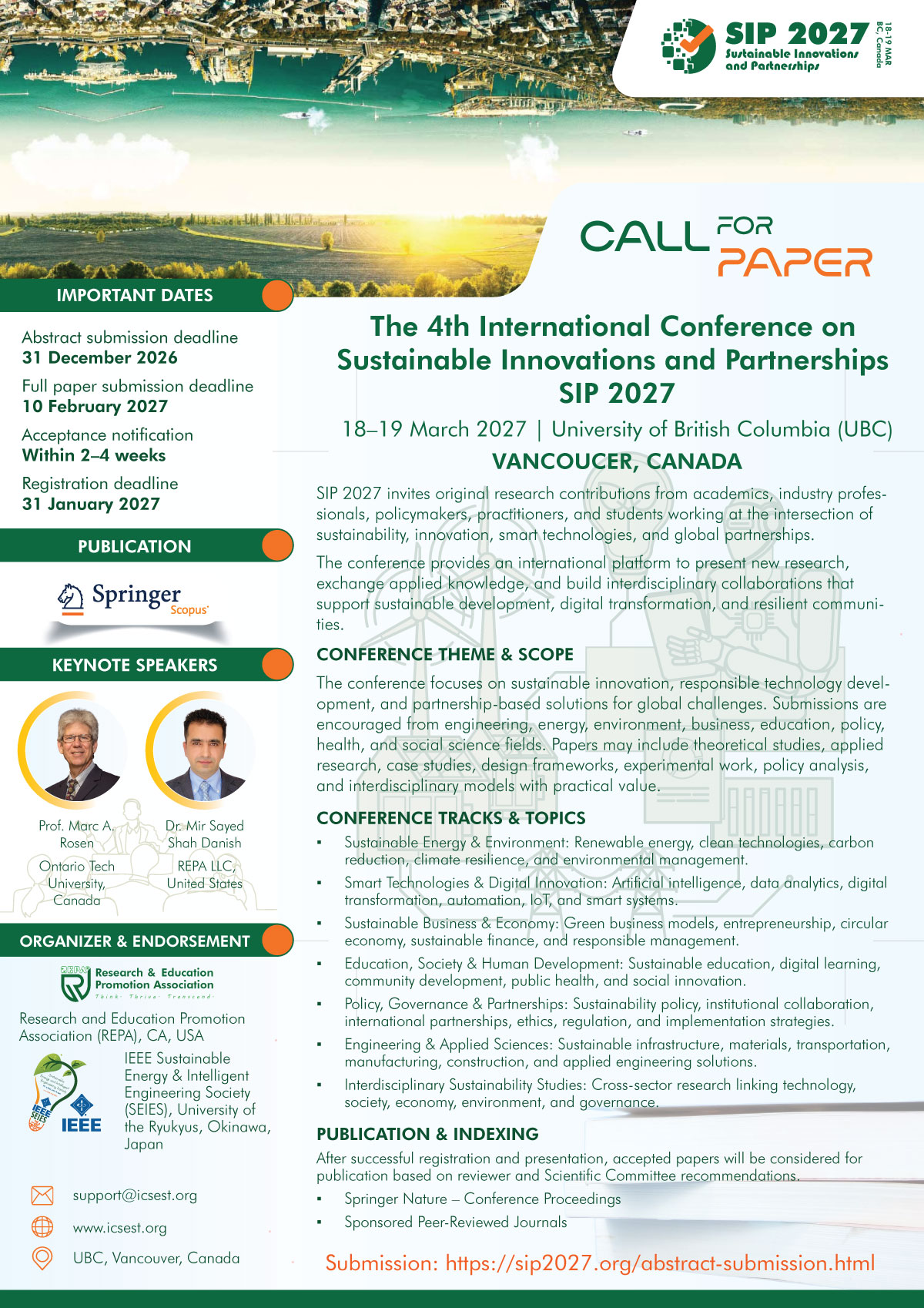
Conference Themes & Research Tracks
- Sustainable energy systems and renewable energy technologies
- Power systems, smart grids, microgrids, and distributed generation
- Energy storage, battery technologies, and hydrogen energy
- Power electronics, energy conversion, and energy efficiency
- Generation, transmission, distribution, and grid reliability
- Energy management, demand response, and low-carbon electrification
- Energy policy, economics, and access to sustainable energy
- Emerging energy technologies and techno-economic optimization
- Climate science, climate change, and global warming
- Climate adaptation, mitigation, and community resilience
- Environmental systems, technologies, and monitoring
- Environmental health, risk, and pollution prevention
- Ecosystems, biodiversity, and natural-resource conservation
- Geospatial analysis, environmental modeling, and remote sensing
- Water resources, sanitation, and sustainable waste management
- Disaster risk reduction and circular resource management
- Artificial intelligence, machine learning, and deep learning
- Data science, big data analytics, and predictive modeling
- AI for sustainable development and scientific research
- Smart cities, digital twins, and intelligent infrastructure
- Internet of Things, sensors, and interconnected systems
- Robotics, intelligent automation, and smart manufacturing
- Computer vision, optimization, and decision-support systems
- Responsible AI, algorithmic fairness, ethics, and digital transformation
- Civil and structural engineering
- Electrical, electronics, and computer engineering
- Mechanical, industrial, and energy engineering
- Environmental and sustainable infrastructure engineering
- Urban planning and architectural engineering
- Sustainable materials, green buildings, and construction
- Transportation, mobility, and communication technologies
- Applied research, engineering innovation, and interdisciplinary systems
- Business economics, finance, and sustainable investment
- Business sustainability management and corporate responsibility
- Entrepreneurship, innovation, and enterprise development
- Sustainable trade, supply chains, and global value chains
- Information systems, business operations, and digital economy
- Leadership, marketing, strategy, and change management
- Program and project management
- Green finance, circular business models, and responsible production
- Plant sciences, agricultural research, and animal husbandry
- Sustainable agriculture and natural resource management
- Food security, nutrition, and sustainable food systems
- Agricultural technologies, automation, and precision farming
- Smart irrigation, water conservation, and crop monitoring
- Climate-smart agriculture and resilient rural livelihoods
- Livestock, food science, and agri-food innovation
- Green agricultural technologies and agricultural-sector studies
- Social and community studies, anthropology, and sociology
- Social statistics and quantitative social research
- Civic, political, legal, and philosophical studies
- Education, lifelong learning, and equitable access
- Public health, social well-being, and community development
- Gender equality, inclusion, and poverty reduction
- Global and intercultural studies
- Mathematics and interdisciplinary social research
- Public policy and sustainable development planning
- Climate, environmental, and energy governance
- Public administration and institutional reform
- International relations and institutional cooperation
- Legal frameworks, regulatory compliance, and accountability
- Ethics, transparency, and good governance
- Digital government, urban governance, and public innovation
- Peace, justice, and strong institutions
- Implementation and evaluation of the 17 Sustainable Development Goals
- Academic–industry collaboration and knowledge exchange
- Public–private partnerships and multistakeholder initiatives
- International scientific cooperation and research networks
- Interdisciplinary research and practical innovation
- Community engagement and participatory development
- Technology transfer, capacity building, and regional initiatives
- Collaborative solutions to global sustainability challenges
Previous Conference Publication Successfully Indexed in Scopus
Our previous conference, CEGS 2024, achieved an important academic publishing milestone through its associated Springer Nature publication, which is indexed in the Scopus database.
This achievement reflects our experience in supporting scholarly publication and the dissemination of research through recognized academic publishing channels. The official Scopus record is available for independent verification.
Verify Previous Conference Publication on Scopus
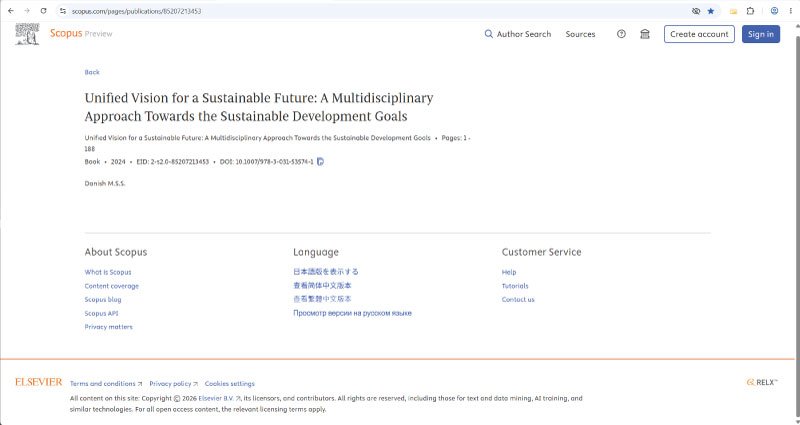
Scopus EID: 2-s2.0-85207213453
Click the image to view the official Scopus record.
Important Dates
| Event | Date |
|---|---|
| Paper and Abstract Submission Deadline | February 15, 2027 |
| Revised Paper Submission Deadline | February 28, 2027 |
| Notification of Acceptance Rolling review; normally within approximately two weeks of submission. | February 28, 2027 |
| Registration Deadline | March 8, 2027 |
| Final Conference Program Announcement | To Be Announced |
| Conference Dates | March 18–19, 2027 |
Submission Categories & Guidelines
SIP 2027 welcomes original research abstracts and full research papers that fall within its nine conference themes. English is the submission language. Contributions are considered under the published scientific review, presentation, and publication arrangements.
- Full Research Paper: Full papers are submitted through the official SIP 2027 full-paper submission page, according to the published author guidelines.
- Research Abstract: Abstracts should contain 200–400 words and be submitted through the SIP 2027 abstract submission portal.
- Research Originality: Submitted contributions should represent original scholarly work, include appropriate citations and acknowledgments, and comply with established principles of research ethics and academic integrity.
- Scientific Evaluation: Submissions are assessed in accordance with the published SIP 2027 Review Process.
- Conference Presentation: Accepted work may be scheduled for oral, poster, or online presentation, subject to the final program and participation arrangements.
- Publication Consideration: Acceptance for presentation does not guarantee publication. Publication decisions are subject to review, editorial approval, and publisher requirements.
Why Submit to SIP 2027?
- International Research Visibility: Present original scientific research and innovative findings to an international academic audience, strengthening research visibility and scholarly exchange.
- Publication Opportunities: Selected papers may be considered for academic conference proceedings or affiliated journals, subject to editorial approval and publication requirements.
- Research Recognition: Awards, if announced, will be specified in the final conference program.
- Flexible Participation: Present accepted research in person in Vancouver, Canada, or through available online presentation arrangements.
- Conference Documentation: Official conference invitation letters are available to eligible registered participants following payment confirmation and administrative verification.
How to Submit Your Research?
Authors are invited to review the submission guidelines and select the appropriate submission category. Research abstracts and full papers are submitted through their respective online submission systems.
- Full Research Papers: Submit full papers through the official SIP 2027 full-paper submission page.
- Research Abstracts: Submit abstracts through the official SIP 2027 abstract submission page.
- Submission Confirmation: Authors are advised to retain their submission reference and monitor official communications regarding evaluation outcomes, revisions, and acceptance decisions.
Selected Springer Publications from Previous Conferences
Previous academic conferences and scholarly initiatives have contributed to Springer publications covering sustainable energy, artificial intelligence, engineering, environmental research, and interdisciplinary sustainability. The following books illustrate established publication outcomes from earlier events.
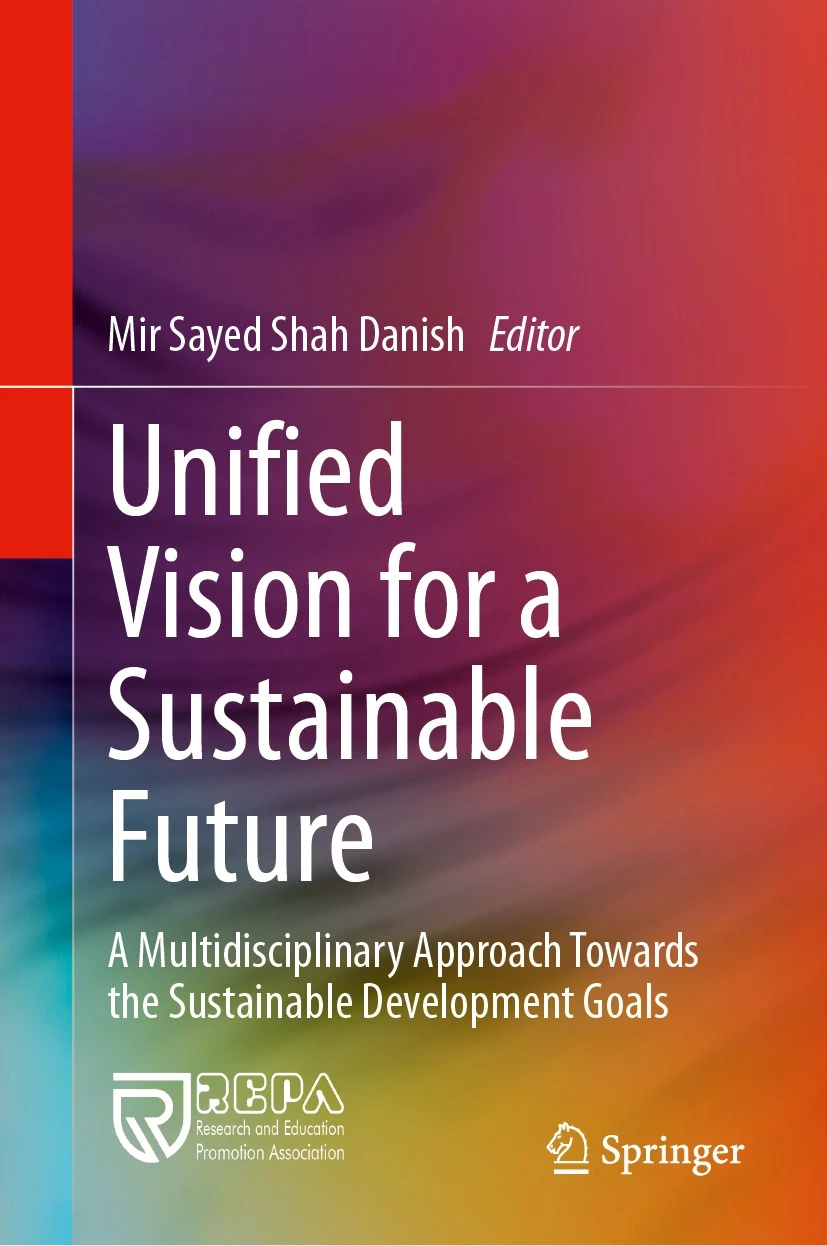
Click cover to enlarge
Unified Vision for a Sustainable Future
A Multidisciplinary Approach Towards the Sustainable Development Goals
- Publisher: Springer Nature (Springer Cham)
- Editor: Mir Sayed Shah Danish
- Conference: CEGS 2024
- Publication Year: 2024
- ISBN: 978-3-031-53576-5
- DOI: 10.1007/978-3-031-53574-1
- Research Focus: Sustainable energy, AI-enabled power systems, environmental sustainability, interdisciplinary research, and the Sustainable Development Goals
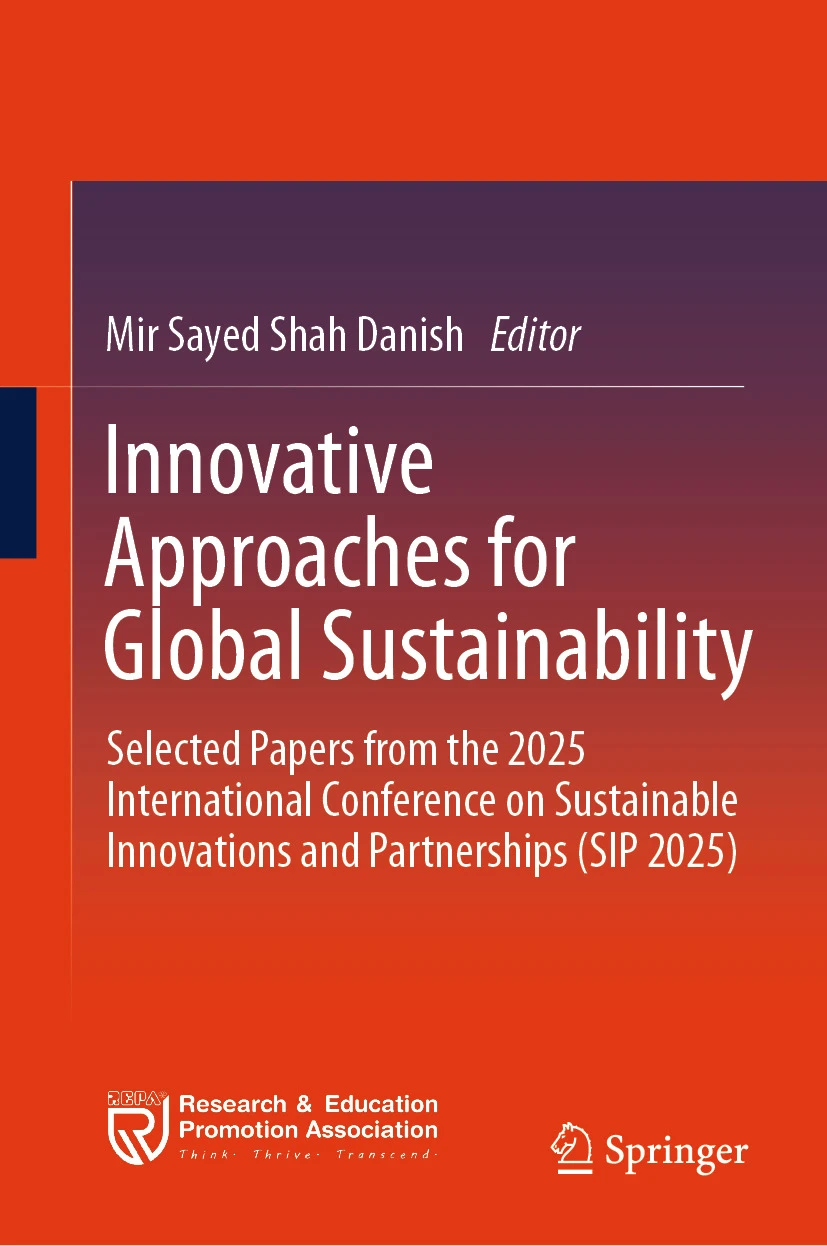
Click cover to enlarge
Innovative Approaches for Global Sustainability
Selected Papers from the 2025 International Conference on Sustainable Innovations and Partnerships (SIP 2025)
- Publisher: Springer Nature (Springer Cham)
- Editor: Mir Sayed Shah Danish
- Conference: SIP 2025
- Publication Year: 2026
- ISBN: 978-3-032-18040-7
- DOI: 10.1007/978-3-032-18038-4
- Research Focus: Sustainability, renewable energy, smart infrastructure, AI applications, climate resilience, and interdisciplinary scientific innovation